
Mascot Costume Sizing: How to Measure a Performer and Get the Fit Right
Almost every mascot listing online says the same thing: “fits 5 ft 6 in to 6 ft 0 in”. That is a shipping label, not a fit specification. Six measurements decide whether a performer can see, walk and work in your costume — here is how to take them and what a factory does with them.
10 min read
In short
- Height is the least useful of the six measurements. Eye height, chest and shoulder width decide whether the costume works; height mostly decides trouser length.
- A well-built costume carries its weight on the shoulders and hips through a harness, not on the performer's neck. That is a construction decision made before anything is cut.
- For a shared costume, build for the tallest and broadest performer and pad down. Padding out a suit that is already too small is not possible.
- Run an eight-point fit test on arrival — mirror, stairs, sit, kneel, reach, wave, walk and vision line. Ten minutes at delivery beats a discovery at an event.
Why “one size fits most” keeps failing
Stock mascot suits are sold with a single height range because a height range is the only number a catalogue can print without asking you anything. It survives as a convention because it is usually survivable: most adults can get into most mascot suits and stand up.
Standing up is not the job. The job is forty-five minutes of walking on uneven ground, kneeling for a photograph with a five-year-old, climbing three steps onto a stage and coming back out able to do it again after a break. The measurements that decide whether that is possible are not the one on the label.
Two performers can both be 172 cm and need genuinely different costumes. One has a 96 cm chest and long legs; the other has a 118 cm chest and a shorter inseam. In a fixed body suit the first one swims in the torso and trips on the cuffs, and the second cannot raise their arms above shoulder height. The costume "fits" both of them in the catalogue sense and neither of them in the working sense.
- Measurements a build actually uses
- 6
- Height spread one well-built suit absorbs
- ± 12 cm
- Fit test that catches most problems
- 10 min
The six measurements a costume is built from
Take these with a soft tape, over the clothing the performer will actually wear inside the suit — a t-shirt and leggings, not a winter coat and not bare skin. Write them down in centimetres. Every serious maker works in centimetres; converting inches at the far end is where mistakes enter.
| Measurement | How to take it | What it decides |
|---|---|---|
| Eye height | Floor to the centre of the pupil, standing straight in flat shoes | Where the vision mesh sits. Get this wrong and the performer looks at the inside of a cheek |
| Chest / bust | Around the fullest part, tape level, arms down, breathe out normally | Body suit pattern width and whether the zip closes over a padded torso |
| Shoulder width | Bone to bone across the back, not over the deltoids | Sleeve pitch and whether the arms can lift above the head |
| Inseam | Crotch to floor in flat shoes | Leg length, and where the knee break falls on a character with short legs |
| Head circumference | Around the widest part, above the ears and eyebrows | Internal cage size and padding depth inside the head |
| Shoe size | EU size, plus foot width if it is unusual | Whether the mascot foot is built over the performer's own shoe or as a boot |
Definitions follow the body-measurement conventions in ISO 8559-1, which is what a pattern maker assumes you used.
Eye height is the measurement people skip
Head sculpts are designed around a vision line — a band of mesh hidden in the mouth, the pupils or a decorative panel. That band is cut once, in a position calculated from a stated eye height. A performer 8 cm shorter than the one the head was built for ends up looking through the character's upper lip.
They will not usually complain about it, either. They will tilt their head back to see, which pitches the head forward, which loads the neck, which is how a two-hour appearance becomes a headache and a stiff neck the next morning. You will hear about the neck. You will not hear about the vision line that caused it.
Where the adjustment actually lives
A costume that "adjusts" is not one with a longer drawstring. Adjustment is designed into four places, and each one has a limit worth knowing before you promise a volunteer they will be comfortable.
1. Head cage
Padded ring plus crown strap, ±4 cm circumference
Sets eye height within a small band and stops the head rotating independently of the face
2. Shoulder harness
Ladder-lock webbing, ±6 cm torso length
Carries head and body weight into the shoulders and hips instead of the neck
3. Torso padding
Removable foam panels, up to 3 cm per side
Fills a suit built for a broader performer so the silhouette still reads correctly
4. Leg and sleeve length
Internal hem with bar-tacked fold, ±5 cm
Keeps cuffs off the floor without cutting the fur, so the change is reversible
The eight-point fit test
Run this the day the costume arrives, in the room, with a second person present. It takes ten minutes. Every problem it finds is cheaper to fix now than the week of your event.
1
Vision line
Standing straight, can they see the floor 1.5 m ahead and a child directly in front?
2
Stairs
Three steps up and down, unassisted, without tilting the head back.
3
Sit and kneel
Sit on a chair, kneel on one knee, stand up again without a hand from the spotter.
4
Head off in five seconds
Timed. If it takes longer, the fastening is wrong for an emergency.
5
Arms overhead
Both arms up and a clap. If the shoulders bind, the sleeve pitch is wrong.
6
Wave and point
The gestures the character will actually do, for a full minute.
7
Walk 50 m
Outside if possible. Watch for cuffs dragging and the head rocking.
8
Mirror check
Performer sees the silhouette. A costume they believe in is a better performance.
Fit is right
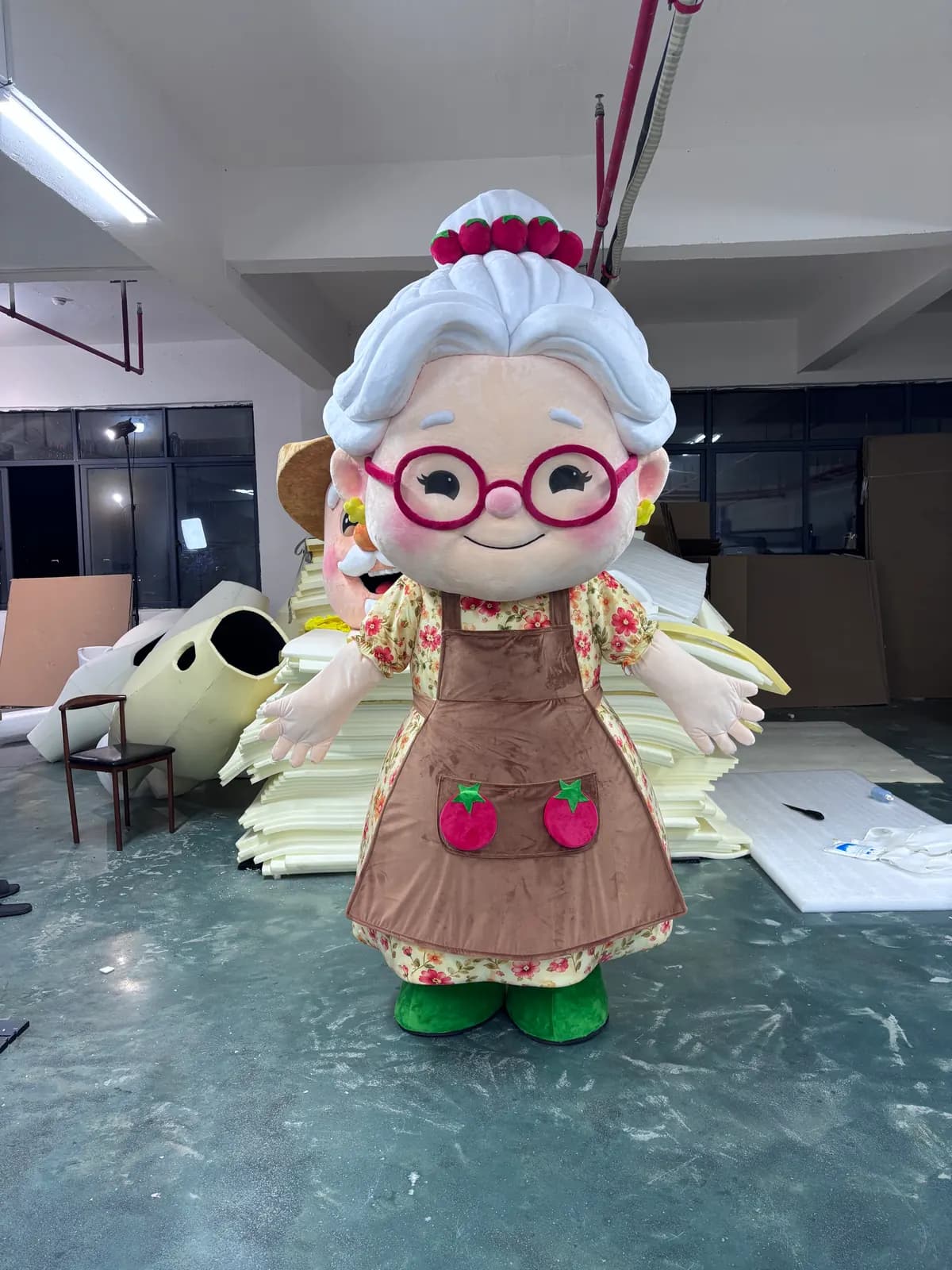
- Head sits level with the shoulders; the performer looks straight ahead
- Weight is felt across the shoulders and hips, not the neck
- Cuffs clear the floor by 2 to 3 cm with shoes on
- Performer can kneel and stand unassisted, twice in a row
Fit is wrong
- Head tips forward; the performer tilts back to find the mesh
- Shoulder seams pull when the arms lift past horizontal
- Trousers concertina at the ankle — a trip hazard on grass
- Head takes two people and fifteen seconds to remove
Symptoms, causes and what to do about them
| What the performer says | Usual cause | Fix |
|---|---|---|
| "My neck hurts after an hour" | Harness not fitted, or head resting on the shoulders | Re-set the harness so the head floats; shorten the torso webbing |
| "I cannot see children in front of me" | Vision mesh cut for a taller performer | Raise the internal cage padding; on a new build, state eye height |
| "I trip on the feet" | Leg length set for the tallest performer on the roster | Take up the internal hem; never cut the fur |
| "The head wobbles when I walk" | Cage circumference too large | Add crown padding, tighten the strap, re-test the walk |
| "I cannot raise my arms" | Shoulder width under-stated at order, or sleeve pitch too low | Release the underarm gusset; on a rebuild, measure bone to bone |
| "It is unbearably hot" | Not a fit problem | See the performer heat guide — rotation and airflow, not size |
Frequently asked questions
What measurements do I need to order a mascot costume?
Six: eye height, chest, shoulder width, inseam, head circumference and shoe size, all in centimetres, taken over the clothing the performer will wear inside the suit. Height alone is not enough — it mostly decides leg length, while eye height, chest and shoulder width decide whether the costume can be seen out of and worked in.
Can one mascot costume fit several performers?
Yes, within roughly a 12 cm height spread for a fitted plush suit and a wider range for an inflatable. Build for the tallest and broadest person on the roster and pad down with removable foam; a suit that is already tight cannot be enlarged. Head socks and cooling vests should be personal, everything else can be shared.
How do I measure eye height for a mascot head?
Have the performer stand straight in flat shoes and measure from the floor to the centre of the pupil. That number tells the maker where to cut the vision mesh. If the costume will be shared, give the range and expect the head cage to be padded for the shorter performers.
Should the mascot feet go over the performer's own shoes?
For a shared costume, yes. Foot covers worn over the performer's own trainers absorb around three shoe sizes and are easy to replace when the soles wear. Moulded boots look better on a stylised character but effectively fit one size, so they suit a single-performer programme.
How much height difference can a mascot costume absorb?
A well-built plush costume with an adjustable harness and internal hems absorbs about ±6 cm from its design point, so roughly a 12 cm span in total. Inflatable bodies absorb more because the shell is not fitted to the body. Anything beyond that needs a re-cut of the body suit, not an adjustment.
What should I check when the costume arrives?
Run the eight-point fit test: vision line, stairs, sit and kneel, head removal within five seconds, arms overhead, wave and point, a 50 m walk, and a look in the mirror. Do it with a second person present on the day it arrives, not the week of the event.
Is a mascot costume unisex?
The outer character is, because the silhouette belongs to the character rather than the performer. The fit underneath is not automatically unisex: chest measurement and shoulder width vary more between individuals than between sexes, which is why we pattern from the numbers rather than from a label.
About the author
- Building mascot costumes in Shenzhen since 2013
- About 3,000 costumes a month, shipped to 60+ countries
- Writes from the cutting table, the sewing line and the pre-shipment QC bench
Sources
External links open in a new tab and are provided for verification, not endorsement.
- 1. ISO 8559-1:2017 — Size designation of clothes: anthropometric definitions for body measurement
- 2. ANSUR II — US Army anthropometric survey, open data set
- 3. CDC/NCHS — Anthropometric reference data for children and adults, United States (Vital and Health Statistics 3/50)
- 4. US Access Board — Anthropometry research: body dimensions and reach