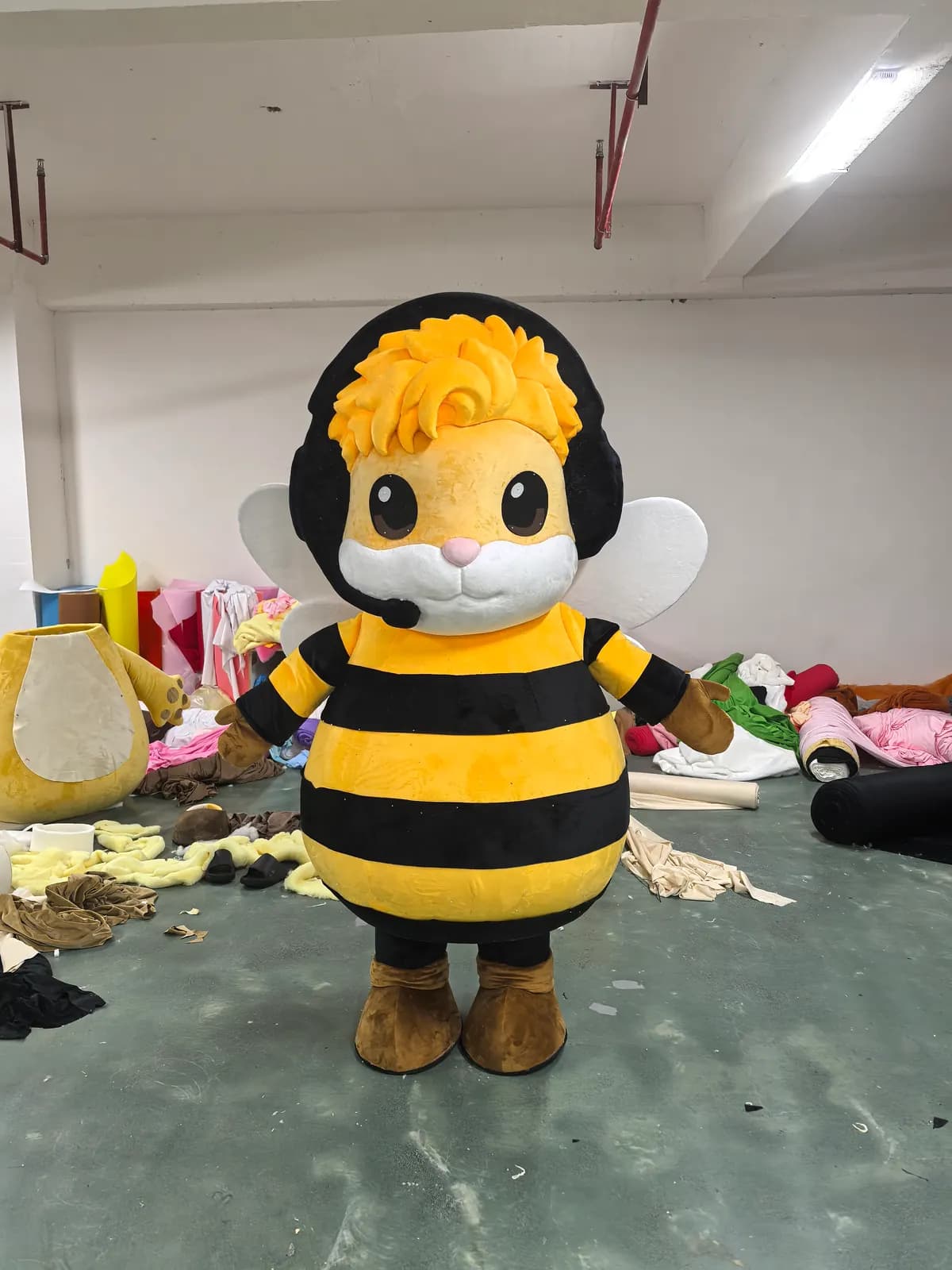
In short
How Hot It Really Gets Inside a Mascot Costume — and How to Keep the Performer Safe
Most advice on this subject amounts to "put a fan in the head and drink water". There is actual published research on mascot costumes, and it says something more specific and more urgent: without cooling, a performer reaches a core temperature of 38 °C in about thirty-five minutes.
In short
- Experimental work on mascot costumes found wearers reached a 38 °C core temperature in roughly 35 minutes with no cooling — which is why "how does he feel?" is not a safety system.
- A mascot costume is close to a vapour barrier, so sweat stops working. Air temperature alone understates the risk badly.
- Build the rotation around a hard clock, not the performer’s judgement: heat impairs exactly the judgement you would be relying on.
- Fans, a crown vent and a load-bearing cage are the three construction features that make a safe rotation possible at all.
What the research actually found
Mascot costumes have been studied properly, which is more than can be said for most of the advice written about them. Two pieces of work are worth knowing about.
A 2023 experimental study in the *International Journal of Low-Carbon Technologies* measured people wearing mascot costumes in summer conditions. Without any cooling, wearers reached a core body temperature of 38.0 °C in about thirty-five minutes. A separate study in *Building and Environment* tested personal cooling suits on mascot actors in hot, humid conditions and found that an appropriate cooling system held core temperature below that threshold across sixty-minute trials.
Thirty-eight degrees is not an arbitrary number. It is the figure occupational heat-stress guidance commonly uses as an action threshold for unacclimatised workers — the point at which a supervisor is supposed to have already intervened, not the point at which someone starts to feel unwell.
- To reach 38 °C core, no cooling
- ≈ 35 min
- Common occupational action threshold
- 38.0 °C
- Held below threshold with active cooling
- 60 min
Why it gets hot so fast: the costume is a vapour barrier
A human being sheds most heat by evaporating sweat. That only works if the water vapour has somewhere to go. Plush over foam over a body suit is close to vapour-impermeable, so the sweat wets the performer and the air next to their skin saturates — and evaporative cooling, the body’s main mechanism, effectively switches off.
This is why the ordinary "feels like" temperature misleads people so badly here. Occupational guidance measures heat stress with WBGT, which combines air temperature, humidity, radiant heat and air movement, and then adds a clothing adjustment factor for anything that impedes heat loss. Impermeable clothing is treated as a special case precisely because the usual arithmetic stops applying to it. A mascot costume sits at the severe end of that scale. A mild 24 °C afternoon in the sun is not a mild day inside the head.
Two details matter more than people expect. First, a fan pointed straight at the face dries eyes and does little for the head as a whole — air has to move across the face and out. Second, a costume with no crown vent recirculates its own hot air no matter how many fans are fitted; you are stirring a closed box.
A rotation schedule you can actually run
Occupational guidance builds work-rest schedules from measured WBGT, workload and acclimatisation. Most people booking a mascot have no WBGT meter and no intention of buying one, so the table below is a conservative field version: it uses conditions you can observe, assumes a costume with working fans, and errs short.
Treat it as a starting point to be shortened, never lengthened. If the performer is new, unacclimatised, in an inflatable with a blower, or doing anything energetic, cut the numbers.
| Conditions | Maximum stint | Minimum break | Notes |
|---|---|---|---|
| Indoors, air-conditioned, under 22 °C | 35 – 45 min | 15 min | The easiest case. Still rotate; the costume does not know the room is cool |
| Indoors, no air conditioning, 22 – 26 °C | 25 – 30 min | 20 min | Crowded halls run hotter than the thermostat says |
| Outdoors, shade, under 24 °C | 25 – 30 min | 20 min | Watch for still air — no breeze removes the crown vent’s advantage |
| Outdoors, direct sun, 24 – 28 °C | 15 – 20 min | 30 min in shade | Radiant load through dark fur is severe. Two performers minimum |
| Above 28 °C, or high humidity, or direct sun at midday | 10 – 15 min | 30+ min, cooled | Consider cancelling the appearance. Nothing is worth a heat stroke |
A conservative field adaptation, not a substitute for a WBGT-based assessment under OSHA guidance. Where you have a legal duty of care, follow your own jurisdiction’s rules.
Step 1
Head off first
Within seconds of leaving the crowd, not once they reach the room.
Step 2
Get the body suit open
The torso sheds far more heat than the head once it is exposed.
Step 3
Cool air and cold fluid
Shade or air conditioning, water or an electrolyte drink, seated.
Step 4
Someone checks them
A named person, every break. Not a glance across the room.
Step 5
Clear the next stint
If recovery is not complete, the next stint does not happen.
What the costume itself has to have
No schedule saves a costume that cannot breathe. These are the construction features that decide whether a safe rotation is even possible, and what we build into ours as standard.
| Feature | Specification | What happens without it |
|---|---|---|
| Head fans | Two or three 12 V fans, positioned to move air across the face and out at the crown | The head becomes a sealed box of the performer’s own exhaled air |
| Battery | Rechargeable pack, 6-10 hours per charge, spare pack supplied | The fans die halfway through the day, which is exactly when they are needed |
| Crown vent | Opening at the top of the head, hidden in the sculpt | Hot air has no exit and simply circulates |
| Vision mesh | Anti-fog panels sized to the individual performer’s eye height | Fogging, which is both a heat symptom and a trip hazard |
| Internal cage | Load-bearing frame transferring head weight to shoulders and hips | The performer works harder to hold the head up, generating more heat |
| Body suit | Moisture-wicking lining against the skin | Chafing and a wet, heavy suit that holds heat against the body |
| Removable garments | Outer clothing that comes off for laundering | The costume cannot be dried properly between appearances |
The full material specification is on our materials and quality control page.
Recognising heat illness through a costume
The hard part is that the costume hides every visual cue you would normally rely on. You cannot see pallor, sweating or unsteadiness through a foam head. You have to listen and watch movement instead — and you have to have decided in advance who is doing the watching.
| Stage | What you can observe from outside | Action |
|---|---|---|
| Early strain | Movement slows, gestures get smaller, the character stops initiating interaction | End the stint now. This is the normal, expected end point — not a failure |
| Heat exhaustion | Stumbling, leaning on things, sitting down unprompted, slurred or absent responses on the radio | Head off immediately, move to shade or air conditioning, cool actively, give fluids, do not leave alone |
| Heat stroke — medical emergency | Confusion, strange behaviour, collapse, seizure, no response | Call emergency services. Remove the costume. Cool aggressively — cold water, ice packs to neck, armpits, groin — while you wait |
General guidance only, and not medical advice. Train your team against OSHA heat illness materials or your national equivalent, and follow local law.
Planning the appearance, not just the costume
- Name a handler for every appearance. One person, not the whole team, whose job is the performer rather than the crowd. Give them a watch and the authority to stop.
- Set the stint length before you arrive, from the conditions and the table above, and write it down. Deciding in the moment always produces longer stints.
- Book a cool-down space within thirty seconds’ walk of where the character appears. A break that costs five minutes of walking will not get taken.
- Charge both battery packs the night before and put the spare in the kit bag. A flat pack turns a compliant costume into a non-compliant one.
- Brief the performer on the signal for ending a stint early, and make it something they can do in character so they never have to weigh dignity against safety.
- Dry the costume fully between appearances. A damp suit is heavier, hotter and, over a season, the reason a costume starts to smell and delaminate.
- Reconsider midday outdoor slots entirely. The cheapest heat control is scheduling the appearance for the morning or the evening.
How it usually goes wrong
- One costume, one performer, a four-hour booking
- Breaks "when he needs one", judged by the person least able to judge
- Cool-down space is the car park, five minutes away
- One battery pack, charged that morning
- Nobody specifically responsible for the performer
How it should be staffed
- Two performers alternating, or one performer and a hard stop at half the booking
- Stint length fixed in advance from the conditions and run on a clock
- Cool room adjacent to the appearance area, with water in it
- Two battery packs, both charged, spare in the bag
- A named handler with authority to end a stint
Frequently asked questions
How long can someone safely stay in a mascot costume?
In warm conditions with no cooling, published research found wearers reached a 38 °C core temperature in about 35 minutes — so treat that as an outer limit, not a target. With working fans and a crown vent, 25-30 minutes indoors and 15-20 minutes in direct sun are sensible maximums, followed by a real break out of the head. Shorten all of it for new performers, high humidity or energetic work.
Do fans in a mascot head actually make a difference?
Yes, provided they move air across the face and out through a crown vent rather than blowing at the performer inside a sealed head. Research on active cooling for mascot actors found that appropriate cooling kept core temperature below the 38 °C threshold across a full hour, where uncooled wearers crossed it in about 35 minutes. Fans without an exhaust path are much less useful.
What temperature is too hot for a mascot appearance?
There is no single number, because humidity, sun and workload matter as much as air temperature — which is why occupational guidance uses WBGT with a clothing adjustment rather than a thermometer reading. As a practical rule, above about 28 °C, or in direct midday sun, or in high humidity, stints should drop to 10-15 minutes and cancelling should be genuinely on the table.
How do I tell if a performer is in trouble when I cannot see them?
Watch movement rather than looking for symptoms. Smaller gestures, slower walking, leaning on furniture, sitting down unprompted or going quiet on the radio all mean the stint ends now. Confusion, strange behaviour or collapse is a medical emergency: call emergency services, get the costume off, and cool aggressively while you wait.
Is an inflatable costume cooler than a foam one?
Not automatically. An inflatable has a blower constantly moving air through the body, which helps, but the shell is usually coated fabric with lower breathability and the blower is loud enough that performers sometimes turn it down. Judge the specific costume on its airflow path, not on the category.
What should I specify when ordering to make the costume safer?
Three things that are easy to leave off a cheap quote: two or three 12 V fans with a rechargeable pack and a spare, a crown vent worked into the sculpt, and a load-bearing internal cage so the performer is not holding the head up with their neck. Then order a spare head so two performers can alternate — that single decision does more for safety than any other option on the list.
About the author
- Building mascot costumes in Shenzhen since 2013
- About 3,000 costumes a month, shipped to 60+ countries
- Writes from the cutting table, the sewing line and the pre-shipment QC bench
Sources
External links open in a new tab and are provided for verification, not endorsement.
- 1. International Journal of Low-Carbon Technologies — An experimental evaluation on thermal comfort and fatigue of humans wearing mascot costumes in summer (2023)
- 2. Building and Environment — On the use of personal cooling suits to mitigate heat strain of mascot actors in a hot and humid environment
- 3. OSHA — Heat Hazard Recognition
- 4. OSHA Technical Manual, Section III Chapter 4 — Heat Stress (WBGT and clothing adjustment factors)
- 5. OSHA — Water. Rest. Shade.
- 6. US National Institutes of Health — Thermal Stress Program (PDF)