What a Mascot Costume Is Actually Made Of — A Specification Sheet
Buying guides describe mascot materials as "premium faux fur" and "high-density foam", which tells you nothing you could put in a purchase order. This is the specification instead: pile lengths in millimetres, which foam does what, where the seams fail, and the standards worth naming.
11 min read
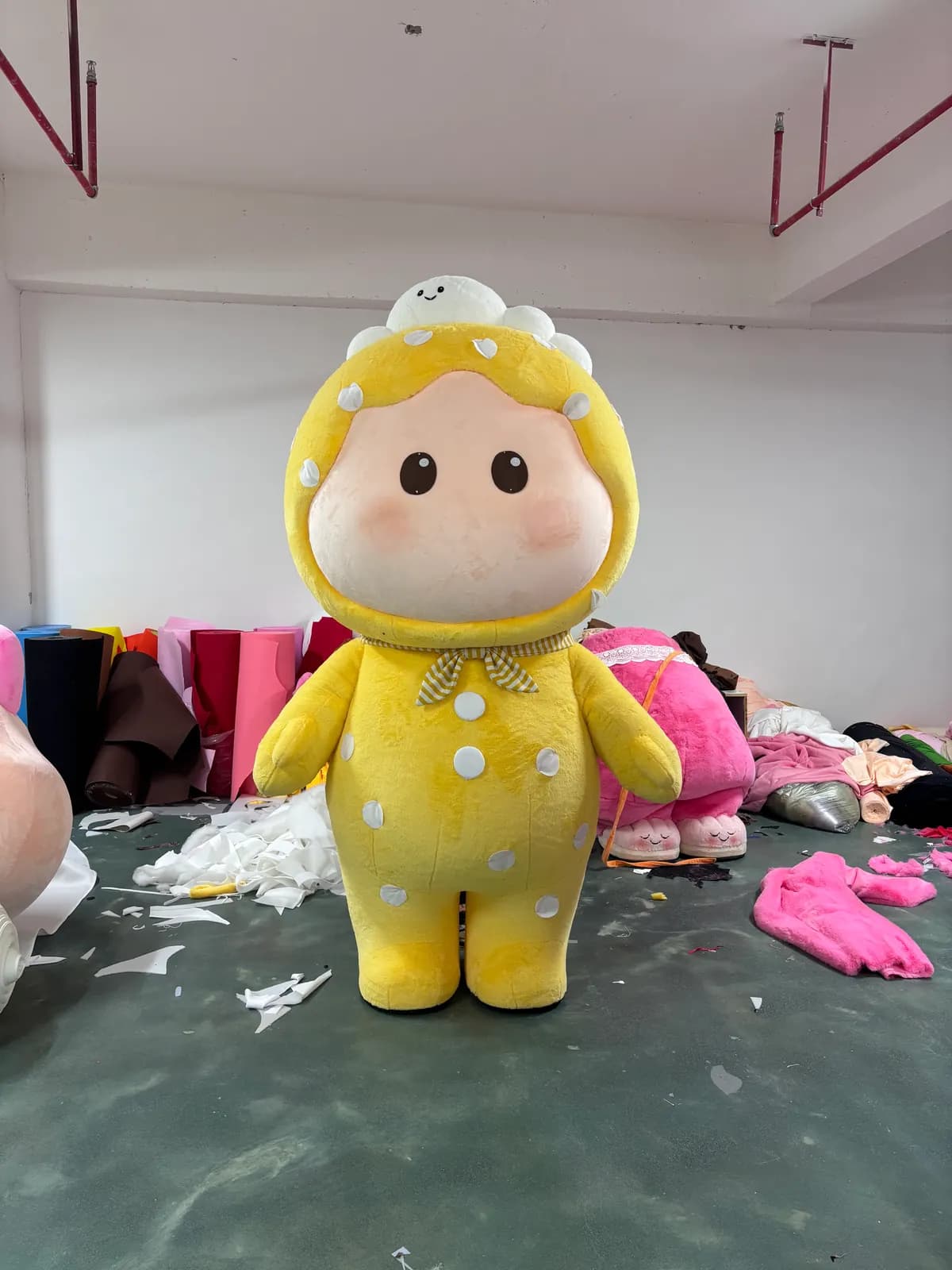
In short
- Fur is specified by pile length in millimetres, not by the word "premium" — 25-40 mm for soft animals, 3-9 mm where detail and close contact matter.
- The head is layered EVA and PU foam doing two different jobs: EVA holds the shape, PU takes the impact and the sweat.
- The load-bearing internal cage is the single most expensive thing to leave out and the single most common thing missing from a cheap quote.
- Costumes fail at four predictable seams. Specify double stitching and bar tacks there and most warranty conversations never happen.
The anatomy of a head, from the outside in
A mascot head is not a shell with fur glued on. It is six layers, each doing a distinct job, and understanding what each one is for is what lets you read a quotation properly.
1. Outer fabric
Long-pile plush 25-40 mm, or velboa 3-9 mm
What the audience sees and photographs. Pile length is chosen per area: long on the body, short on the face so detail reads.
2. Structural foam shell
Layered EVA and PU, hand-carved to the approved sculpt
Holds the silhouette without inflation. Carved rather than moulded, because a one-off character does not justify a mould.
3. Apertures and mesh
Anti-fog vision panels, hidden intake mesh, crown vent
Sightlines and the airflow path. Sized to the individual performer’s eye height, not to a standard head.
4. Airflow cavity
Two or three 12 V fans, wiring loom, rechargeable pack
Moves air across the face and out at the crown. Without the cavity and the vent the fans just stir hot air.
5. Load-bearing cage
Internal frame transferring weight to shoulders and hips
Takes the head off the performer’s neck. This is the layer that decides whether an hour in costume is tiring or injurious.
6. Comfort lining
Moisture-wicking fabric against the skin
Absorbs sweat, prevents chafing, and keeps the foam from soaking — which is what makes a costume start to smell.
Outer fabrics: specify millimetres, not adjectives
"Premium faux fur" is not a specification. Pile length is, and it is the number that decides how a character reads from ten metres and how it survives a season.
| Fabric | Specification | Where it goes | Watch out for |
|---|---|---|---|
| Long-pile plush | 25 – 40 mm pile | Bears, lambs, soft animal characters — the body and limbs | Cheap long pile mats and sheds within a season. Ask for a swatch and rub it hard |
| Short-pile plush / velboa | 3 – 9 mm pile | Faces, detailed characters, anywhere with close contact | Detail disappears under long pile — a face in 30 mm fur reads as a blur |
| Ripstop nylon / coated polyester | Coated, seam-sealed | Inflatable body shells | Lower breathability. Judge the airflow path, not the category |
| Stretch knit body fabric | Four-way stretch | Body suits under the outer shell | Poor recovery means bagging at the knees and elbows by week three |
| Moisture-wicking lining | Knit, against the skin | Head lining and body suit interior | The commonest thing omitted silently from a budget build |
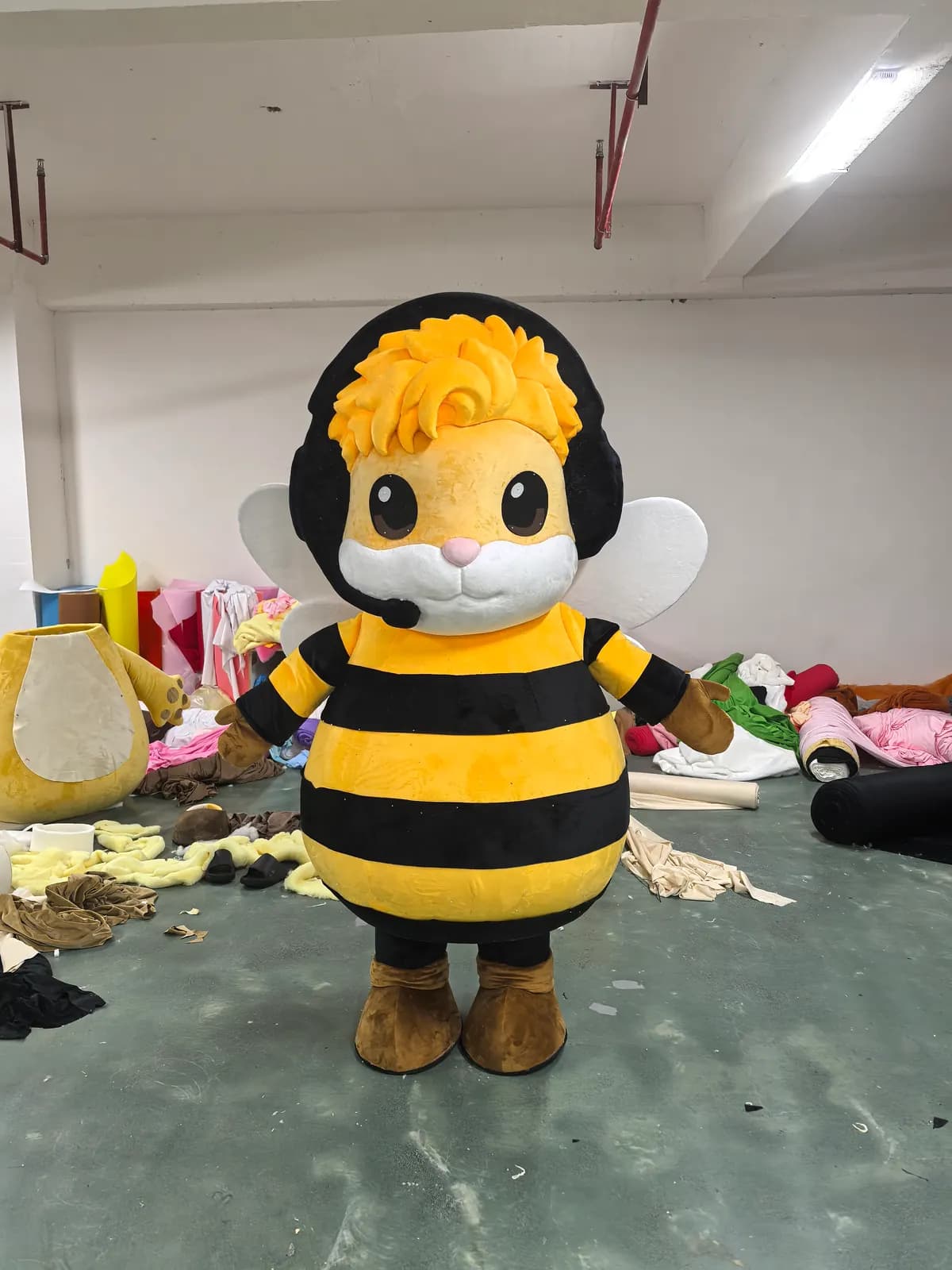
The nap question that nobody asks
Pile fabric has a direction. Cut two adjacent panels with the nap running differently and they will read as two different colours under stage lighting, no matter that they came off the same roll. Getting this right costs fabric — you cannot nest the pattern pieces as tightly — which is precisely why it is the first economy a cheap supplier makes.
It is also the easiest defect to spot in a photograph, so ask for a straight-on shot of the finished costume under normal light before the balance payment.
Foam and frame: two foams, two jobs
Heads are built from layered EVA and PU foam because the two materials do opposite things well. Suppliers who use only one are optimising for their own convenience.
| Material | Property | Role in the head |
|---|---|---|
| EVA foam | Closed cell, firm, holds a carved edge | The structural shell. Keeps the silhouette and resists deformation in storage and transport |
| PU foam | Open cell, softer, compressible | Contact surfaces and shaping. Absorbs knocks and conforms to the performer |
| Reinforcement at the crown | Additional layer where the harness attaches | The single most common failure point on cheap builds — the harness pulls through |
The cage is the line between a costume and a burden
A mascot head weighs a few kilograms. Where that weight lands determines whether the costume is wearable for a season. With an internal cage, the load transfers through a frame onto the shoulders and hips, the way a rucksack’s hip belt works. Without one, it sits on the performer’s head and neck, and the complaints begin as neck ache and end as a costume nobody will wear.
This is expensive to build and invisible in every photograph, which makes it the first thing removed from a quote that has to hit a number. When you are comparing two suppliers, this is the question that most often explains the price gap. Ask directly: is there a load-bearing internal cage, and can I see a photograph of it?
Cooling: the specification that keeps someone safe
This section is short because we have written about it at length: published research found mascot wearers reached a 38 °C core temperature in around thirty-five minutes with no cooling. The full picture, with a rotation schedule, is in our guide to performer heat safety. What follows is only the hardware.
| Component | Specification | Why this number |
|---|---|---|
| Head fans | Two or three, 12 V | One fan cannot move enough air through a head this size. Position matters more than count: across the face, not at it |
| Battery pack | Rechargeable, 6 – 10 hours per charge, spare supplied | A full event day exceeds a single charge. The spare is not an upsell, it is the difference between a compliant costume at 3 p.m. and a non-compliant one |
| Crown vent | Aperture at the top of the head, worked into the sculpt | Hot air rises. Without an exit the fans recirculate the performer’s own exhaled air |
| Vision mesh | Anti-fog, sized to the individual performer’s eye height | Fogging is both a heat symptom and a trip hazard. Eye height is per-person, so send measurements |
| Wiring | Loomed and secured, connector accessible without removing the head | A fan you cannot switch on mid-event without undressing is a fan that stays off |
Seams and hardware: where costumes actually fail
Costumes rarely fail in the middle of a panel. They fail at four predictable places, and every one of them is cheap to reinforce at the point of manufacture and expensive to repair afterwards.
- Armpit. The highest-cycle seam on the whole costume. Every wave, every hug, every high-five loads it.
- Crotch. Sitting, squatting and stairs. It opens with no warning and ends an appearance immediately.
- Crown attachment. Where the harness meets the head shell. Failure here drops the head, which is a safety incident, not a repair.
- Glove and foot junctions. Constant abrasion against surfaces and, in retail work, against floors that are never as clean as anyone thinks.
| Item | Specify | Rather than |
|---|---|---|
| Stress seams | Double-stitched and bar-tacked at the four points above | Single stitching throughout, which is faster to sew and the reason for most warranty claims |
| Zippers | Standard-gauge, replaceable, with a storm flap over the back closure | Proprietary or undersized zips you cannot source a replacement for |
| Trim and detail | Sewn where the design allows | Glued, which peels once the costume gets damp and then gets warm |
| Outer garments | Removable, so they can be laundered separately | Fixed clothing, which forces full professional cleaning every time |
| Spares supplied | Gloves, feet covers, repair kit, spare battery, matched offcut fabric | Nothing — and matched fabric is impossible to source once the dye lot is gone |
The matched offcut matters more than people expect. Two years on, a repair with fabric from a different dye lot is visible from across a room.
Safety standards worth naming in the order
Mascot costumes sit in an awkward regulatory space. They are not toys, but they are used around children, and venues frequently impose their own fire requirements. Naming a standard in your purchase order converts a vague expectation into a testable one.
| Standard | Covers | Specify it when |
|---|---|---|
| EN 71-2 | Flammability of toy materials | Selling into the EU or UK, or working close to children |
| EN 71-3 | Migration of certain elements from materials | Anywhere the costume is handled by children. EU migration limits are strict enough that meeting them generally satisfies US content limits too |
| ASTM F963 | US toy safety, mechanical and physical | US market, especially where the character is merchandised alongside toys |
| Venue flame-retardancy rules | Fabric behaviour in a specific building | Arenas, theatres, schools and exhibition halls — ask the venue, in writing, before you order |
| Nickel-free / low-migration hardware | Skin contact with fittings | Any costume used around children, or where performers have known sensitivities |
We can supply compliant materials and flame-retardant fabric options on request — but only if the requirement is in the brief. Retro-fitting a standard after production is not possible, so raise it at quotation.
A specification you can send to any supplier
Copy this into an email. It is deliberately supplier-neutral — send it to us and to two competitors, and compare the answers rather than the prices. The quotations that come back will be genuinely comparable, which is more than most buyers ever achieve.
- Outer fabric — state pile length in mm for body and for face separately, and confirm nap direction is consistent across adjacent panels.
- Foam — confirm layered EVA and PU, hand-carved to the approved sculpt, with a reinforced crown where the harness attaches.
- Internal frame — confirm a load-bearing cage transferring head weight to shoulders and hips, and send a photograph of it.
- Cooling — number and voltage of fans, position, crown vent, battery run time per charge, and confirm a spare pack is included.
- Vision — anti-fog mesh, sized to a performer eye height I will supply.
- Seams — double stitching and bar tacks at armpit, crotch, crown attachment and glove/foot junctions.
- Hardware — standard-gauge replaceable zippers with a storm flap; sewn trim rather than glued.
- Garments — outer clothing removable for laundering.
- Spares — gloves, feet covers, repair kit, spare battery, and matched offcut fabric from the same dye lot.
- Standards — name any of EN 71-2, EN 71-3, ASTM F963 or venue flame-retardancy that applies to me.
- Sizing — performer height range and eye height; confirm how the harness adjusts between performers.
- Evidence before balance payment — filmed walk test of my costume, photographs of the interior, signed per-unit checklist, colour against approved swatch, photographs as packed.
Frequently asked questions
What fur is used on mascot costumes, and how do I specify it?
Specify pile length in millimetres rather than asking for "premium" fur. Long-pile plush of 25-40 mm suits bears, lambs and soft animal characters; short-pile plush or velboa at 3-9 mm is right for faces and detailed characters, because fine detail disappears under long pile. Ask for a physical swatch card with the pile length written on it before you commit.
What foam is a mascot head made from?
Layered EVA and PU foam, hand-carved to the approved sculpt. EVA is closed-cell and firm, so it holds the silhouette and resists deformation in storage; PU is open-cell and softer, so it absorbs knocks and conforms to the performer. The crown needs an extra reinforcement layer where the harness attaches, because that is where cheap builds pull through.
What is an internal cage and do I really need one?
It is a load-bearing frame inside the head that transfers the weight onto the shoulders and hips instead of the neck, the way a rucksack hip belt does. Yes, for anything worn regularly. It is expensive to build, invisible in photographs and therefore the first thing cut from a quote that has to hit a low number — so ask directly and ask for a photograph.
Where do mascot costumes usually fail?
Four places, almost always: the armpit, the crotch, the crown where the harness attaches, and the glove and foot junctions. Specify double stitching and bar tacks at all four and most warranty conversations never happen. Crown failure is the serious one, because it drops the head.
Which safety standards apply to mascot costumes?
They are not toys, so nothing applies automatically, but naming a standard makes the requirement testable. EN 71-2 covers flammability and EN 71-3 covers migration of certain elements for the EU and UK; ASTM F963 is the US toy safety standard. Venues often impose their own flame-retardancy rules, so ask the venue in writing before ordering. All of this has to be in the brief — it cannot be retro-fitted after production.
How should I clean and store a costume so the materials last?
Specify removable outer garments at the order stage so clothing can be laundered separately instead of the whole costume going for professional cleaning. Dry the costume completely between appearances — a damp suit is heavier, hotter and the reason costumes start to smell and delaminate. Store the head supported so the foam is not compressed, and keep the matched offcut fabric with it for repairs.
About the author
- Building mascot costumes in Shenzhen since 2013
- About 3,000 costumes a month, shipped to 60+ countries
- Writes from the cutting table, the sewing line and the pre-shipment QC bench
Sources
External links open in a new tab and are provided for verification, not endorsement.