What a Custom Mascot Costume Actually Costs — and Where the Money Goes
Every pricing guide online tells you a custom mascot runs $5,000 to $15,000. None of them shows you what you are buying with it. We build these for a living, so here is the arithmetic — stage by stage, with the freight and duty most comparisons quietly leave out.
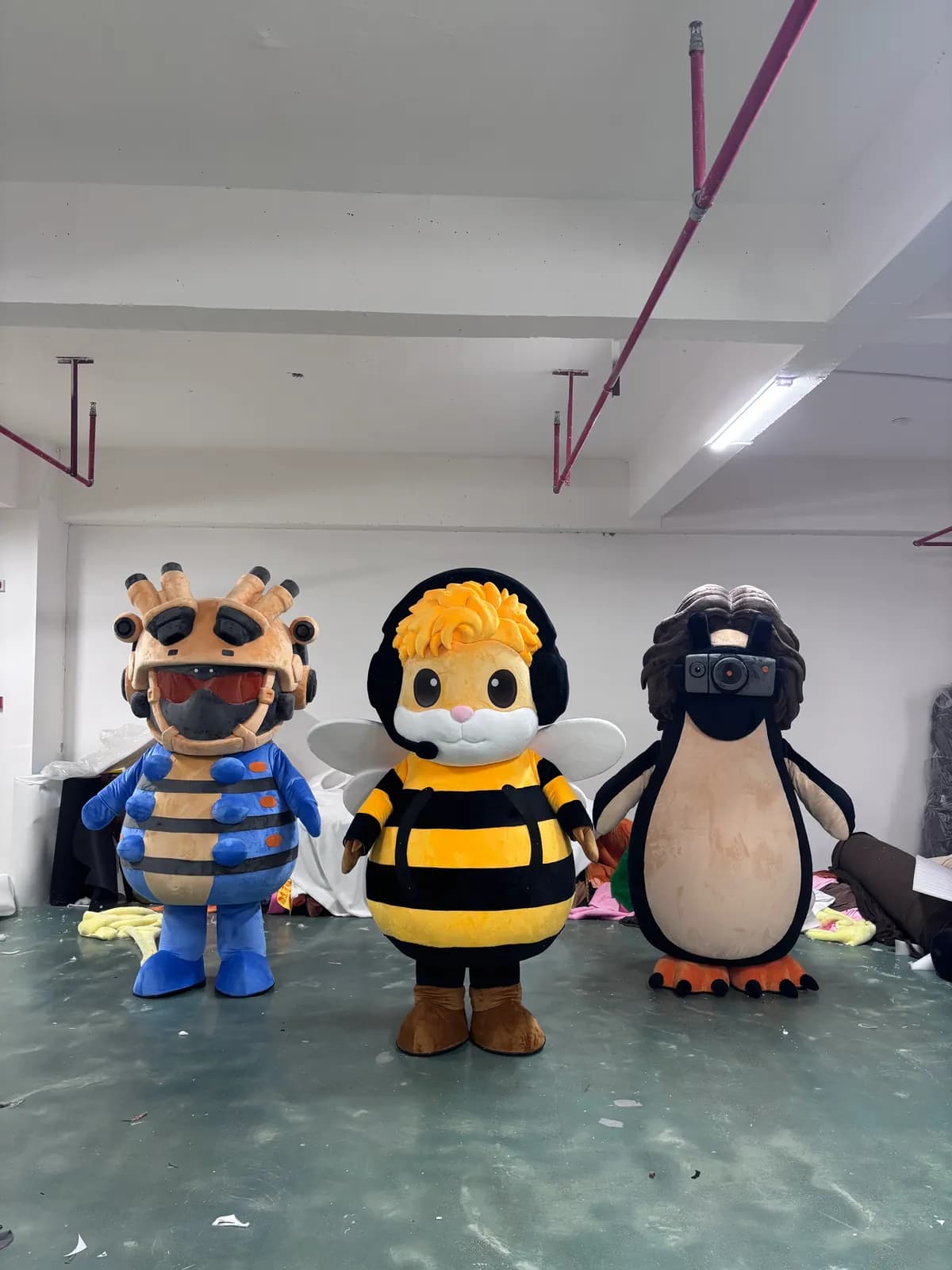
In short
- A custom mascot costume is roughly 12 to 21 working days of skilled handwork — the price is labour, not fabric.
- Domestic makers in the US and Europe publish $5,000-$15,000 for full custom. That figure is consistent with their labour costs, not evidence of a markup.
- Factory-direct ex-works pricing sits at USD 400-1,200, but a fair comparison has to add freight, duty and broker fees before it means anything.
- The cheapest quote usually removes the cage, the fans and the QC — the three things that decide whether the costume survives its second season.
What the market actually charges in 2026
Start with published numbers rather than our own. The figures below come from mascot makers who put their pricing online, and every one is linked at the foot of this article so you can check it.
The spread is enormous — a factor of thirty between the cheapest stock suit and a flagship sports mascot. That spread is the whole story, and almost nobody explains it.
| Tier | Typical price | What you get | Lifespan |
|---|---|---|---|
| Stock / off-the-shelf | USD 500 – 2,000 | A generic animal or character from an existing pattern, no artwork of yours involved | 1 – 2 seasons |
| Semi-custom | USD 2,000 – 5,000 | An existing base pattern recoloured and re-trimmed to your brand | 2 – 4 seasons |
| Full custom, domestic maker | USD 5,000 – 15,000+ | Built from your artwork by a studio in your own country | 5 – 10 seasons |
| K-12 school budget, typical | USD 3,500 – 6,500 | What most American schools actually spend | 4 – 8 seasons |
| Full custom, factory-direct | USD 400 – 1,200 ex-works | Built from your artwork in Shenzhen, before freight and duty | 5 – 10 seasons |
Tiers 1-4 are the published figures of The Mascot Store, Olympus Mascots and School Branding Agency. The last row is our own ex-works range, which is not comparable until you add freight and duty — we do that in section four.
The price is labour, not fabric
People assume a mascot costume is expensive because of exotic materials. It is not. The plush, the foam, the mesh, the fans and the hardware in a mid-range character add up to a modest share of the price. What you are really buying is a fortnight of skilled hands.
Here is our own published production schedule — the same one on our custom process page, not a set of figures written for this article.
Stage 1
Brief and quotation
Artwork reviewed, construction decided, firm price issued. Within 12 working hours.
Stage 2
Digital proof
Turnaround drawing showing proportions, colour placement and seam lines. 2-3 days.
Stage 3
Foam sculpting
The head is carved by hand from layered EVA and PU foam to the approved sculpt. 3-5 days.
Stage 4
Patterning and sewing
Patterns drafted, plush cut on the correct nap, body and garments sewn. 5-10 days.
Stage 5
Assembly and QC
Cage fitted, fans wired, 18-point checklist signed, walk test filmed. 2-3 days.
Stage 6
Packing and shipping
Vacuum-packed where construction allows, boxed, photographed as packed. 1-2 days.
Add stages two through five and a single custom character occupies twelve to twenty-one working days of the workshop. Some of that overlaps — a sculptor and a machinist can work on the same costume in the same week — so the hands-on total is lower than the calendar total. But even on the most generous reading, you are looking at well over a hundred hours of skilled craft per costume.
That is what a mascot costume is. It is not a manufactured product in the sense that a moulded plastic chair is a manufactured product. It is closer to a piece of theatrical wardrobe, and it is priced like one.
Run the same hours through a domestic wage bill
The US Bureau of Labor Statistics puts the mean hourly wage for sewing machine operators at roughly USD 17. A small studio cannot bill at its wage rate: once payroll taxes, benefits, rent, insurance, equipment and non-billable time are loaded on top, a workshop typically has to recover somewhere in the region of USD 45-70 for every hour of shop time just to stay open. That is an industry-typical loading, not a published figure — treat it as the order of magnitude, not the decimal point.
Put a hundred-odd hours of that against a costume and you land between four and seven thousand dollars before a single metre of plush is bought, before the studio takes any profit, and before the design fee that most makers charge separately. The published domestic prices are not a markup. They are what those hours genuinely cost in a high-wage economy.
Where your money actually goes
Comparing an ex-works factory price against a delivered domestic price is the oldest trick in import sourcing, and it is dishonest. Below, both routes are shown as the buyer experiences them — everything you pay, from first invoice to the box on your loading dock.
- Costume
- Design fee
- Freight & crating
- Duty & broker
Even after freight and customs, the gap is roughly five to one. That is the number worth arguing about — not the ex-works price, which on its own tells a buyer nothing useful.
Working out your real landed cost
Three lines turn a factory quote into a number you can put in a budget. None of them is difficult, and any supplier who will not walk you through all three is not worth ordering from.
| Line | Typical figure | What decides it |
|---|---|---|
| Ex-works costume | USD 400 – 1,200 | Size, construction, number of separate garments, fan and battery spec |
| Air express, door to door | USD 180 – 350 | A boxed mascot is light but bulky. Carriers charge on volumetric weight, so the carton size drives this more than the actual kilos |
| Sea freight, LCL | USD 60 – 140 | Far cheaper, but add 30-45 days. Sensible for sets and volume orders, rarely for one urgent costume |
| Customs duty | Varies — confirm before you order | Depends on how your broker classifies the costume. See the warning below |
| Broker / clearance fee | USD 40 – 120 | Flat-ish per shipment, so it hurts less on larger orders |
| Typical landed total, one costume by air | USD 700 – 1,700 | Against USD 5,000-15,000 domestic |
Freight and clearance figures are indicative for a single boxed costume from Shenzhen. Get a live quote — rates move with fuel, season and carrier.
What actually moves the price up or down
Within our own USD 400-1,200 range, these are the variables that decide where a given character lands. They are the same variables that move a domestic quote from five thousand to twelve — the arithmetic is identical, only the hourly rate differs.
| Decision | Effect on price | Worth paying for? |
|---|---|---|
| Head size and complexity | Large sculpted heads with undercuts, teeth or moving jaws add sculpting and patterning days | Yes if the head is the character. It is the first thing anyone photographs |
| Number of separate garments | Each removable garment is its own pattern, cut and sew cycle | Yes — removable clothing is how a costume gets laundered instead of ruined |
| Fur pile and quality | Long-pile 25-40 mm plush costs more than short-pile velboa and takes longer to work with the nap running correctly | Yes for animals. Cheap fur mats and sheds within a season |
| Cooling system | Two or three 12 V fans, a rechargeable pack and the wiring loom | Almost always. See our guide to performer heat |
| Internal cage and harness | A load-bearing frame that moves head weight onto the shoulders and hips | Yes. This is the single most common thing missing from a suspiciously cheap quote |
| Inflatable vs foam construction | Inflatables need a blower, a shell and different patterning; usually above the standard range | Depends entirely on the character silhouette |
| Order quantity | Patterns are drafted once. Repeat pieces from an archived pattern drop substantially | Order the spare head with the costume, not two years later |
| Rush production | 14-18 days instead of 22-30, subject to capacity, at a premium | Only if the event date is genuinely immovable |
- Standard build, from artwork approval
- 22 – 30 days
- Repeat order from an archived pattern
- 12 – 18 days
- A set of three to six characters
- 30 – 40 days
Where a cheap costume costs you more
There is a floor below which a mascot costume stops being an asset and becomes a recurring expense. We know exactly where it is, because we get asked to repair the results.
Built to survive its second season
- Internal cage transfers head weight to the shoulders and hips, so the performer’s neck does not carry it
- Reinforced crown where the harness attaches — the first failure point on cheap builds
- Double-stitched and bar-tacked seams at the four common stress points
- Removable garments so the costume can be laundered rather than sponged
- Replaceable standard-gauge zippers, not proprietary hardware you cannot source
Built to hit a price
- Head rests directly on the performer, which is why the complaints start as neck ache
- Single-stitched seams that open at the armpit and crotch first
- Fur glued rather than sewn at the trim lines, which peels once it gets damp
- Fixed clothing, so the whole costume has to be professionally cleaned every time
- No fan, or one underpowered fan with no spare battery
Add the running costs the pricing guides do mention — around USD 150-600 a year in cleaning and repairs — and a costume that fails in season two has cost you more than the one that lasted six. The saving is real on the invoice and imaginary over the life of the asset.
What to budget, by what you are actually doing
Prices in isolation are useless. Here is what we would tell a buyer to set aside, including freight and a sensible contingency, based on what the costume has to survive.
| Use case | Duty cycle | Budget to set aside | Specify without fail |
|---|---|---|---|
| Single promotional event | A handful of appearances | USD 700 – 1,000 | One fan, basic cage, removable garments |
| School or university mascot | Weekly through a season, student performers of different heights | USD 900 – 1,400 | Adjustable harness, two fans, spare battery, washable garments |
| Sports team, full season | Multiple appearances a week, high energy, filmed | USD 1,200 – 1,900 | Reinforced cage, three fans, spare head, spare gloves and feet |
| Theme park or resort, character set | Daily, hours at a time, multiple performers | USD 1,100 – 1,700 per character | Full spares package, laundering plan, matched colour across the set |
| Retail or brand activation tour | Travelling, packed and unpacked constantly | USD 900 – 1,500 | Pack-flat construction, hard case, replaceable trim |
Ranges are landed by air into the US or EU and assume the spares that make a costume maintainable. Ask us for a firm number against your artwork — we quote from the drawing, not from a range.
Frequently asked questions
Why is a Chinese factory price so much lower than a US or European maker?
Almost entirely labour. A custom mascot costume takes twelve to twenty-one working days of skilled handwork, and those hours cost several times more in a high-wage economy. Buying factory-direct also removes the reseller margin. It is not a materials difference — good factories buy the same Korean and Japanese plush that good Western studios use.
What is the real, all-in cost of importing one costume?
For a single costume flown from Shenzhen to the US, expect roughly USD 700 to 1,700 landed: the ex-works price of USD 400-1,200, air express of USD 180-350, a broker fee of USD 40-120, and duty that depends on classification. Sea freight cuts the shipping line to around USD 60-140 but adds 30-45 days.
How much duty will I pay on a mascot costume?
We will not guess, and neither should any supplier. Classification of costumes is contested and turns on durability — flimsy dress-up costumes have been treated as festive articles, while durable professional costumes generally fall under textile apparel, which carries duty. Rates also vary by country and material. Look it up in the USITC schedule and have a licensed broker confirm it against your specification.
Is a USD 500 mascot costume ever a reasonable buy?
Yes, for a genuinely short duty cycle — a one-off launch, a photo shoot, a single trade show. What you should not do is put a 500-dollar costume in front of a school crowd every week for a season. Ask specifically whether it has an internal cage and a fan; if the answer is no, you are buying for a handful of appearances.
Do I need to pay a separate design fee?
Not with us. Domestic makers commonly charge USD 500-2,000 to develop or redraw a character, which is a real cost of their time. We produce a digital proof from your artwork inside the quoted price, and we do not start cutting until you approve it. If you have no artwork at all, tell us at the brief stage.
Does ordering more than one costume reduce the price much?
Meaningfully, yes, because patterning happens once. A repeat piece from an archived pattern builds in 12-18 days instead of 22-30 and costs noticeably less. The practical advice is to order the spare head — and a second costume if you know you will need one — at the same time as the first, rather than two years later when the pattern has to be re-proofed.
About the author
- Building mascot costumes in Shenzhen since 2013
- About 3,000 costumes a month, shipped to 60+ countries
- Writes from the cutting table, the sewing line and the pre-shipment QC bench
Sources
External links open in a new tab and are provided for verification, not endorsement.
- 1. The Mascot Store — Custom Mascot Costume Cost: 2026 Pricing Guide
- 2. Olympus Mascots — Mascot Pricing: How Much Does A Custom Mascot Cost?
- 3. School Branding Agency — School Mascot Costume Cost: What to Budget in 2026
- 4. Promo Bears USA — How much does professional mascot design cost in 2026?
- 5. USITC — Harmonized Tariff Schedule of the United States (search tool)
- 6. US Bureau of Labor Statistics — Occupational Employment and Wages, Sewing Machine Operators